Spring Scavenger Hunt; Contacting State Legislators about plastic bags, and the EPA about SINKEX
Beautiful weather for this class! We went on a spring scavenger hunt. Here is our list:
dandelion
painted turtle
fish feeding in the pond
salamander
sow bug
earthworm
centipede or millipede
wildflower (that is not a dandelion)
robin on the ground
robin flying
robin in a tree
grackle
fern fiddleheads
princess pine
chipmunk hole
hear a chickadee calling
Bonus: If one of the following is found, it may substitute for an item on the list above: butterfly, snapping turtle, snake, frog, woodpecker, moss with sporangia
We started searching in the playing fields on our way to the trail, then went to the pond and followed the trail loop. At the pond, we threw some bread crumbs in the water and got the fish to feed near us. We spotted one painted turtle on a log. Along the trail, we turned some logs over to find the sow bug, earthworm, centipede and salamander. We found everything on our main list, PLUS these bonus items: butterfly, moss with sporangia! Other things that we found that were not on the list were slugs and a snail. While we searched, we also collected data for the phenology (seasonal changes) database (see Apr. 1 post).
checking out the fish feeding
fern fiddleheads
princess pine
red-backed salamander
moss with sporangia
Back at the Science Center, our scavenger hunt prize was homemade chocolate chip cookies!
While eating, we learned that the Massachusetts State Legislature will be voting on whether to ban single-use plastic bags from larger retail stores. Since we've been interested in reducing plastic bag use (see our recent post on litter, and an early post on re-usable bags), we decided to send emails to our state senator and representative, asking them to vote "yes" to ban the bags! Also, we learned that the Environmental Protection Agency (EPA) will be considering whether or not to prohibit the U.S. Navy from continuing to sink old warships containing hazardous chemicals during target practice at sea. This torpedo and gunnery practice is called SINKEX. We decided to send an email to the EPA to ask that SINKEX be prohibited. If you would like to email the EPA, here's the address: ow-docket@epa.gov
Wednesday, 1 May 2013
Sunday, 21 April 2013
Earth Day Litter Project and Oil spill clean-up Simulation
Earth Day is April 22. The Green Rangers learned that this annual day to support environmental protection was first held in 1970 in the United States. Now it is observed in 192 countries!
We continued our Earth Day litter project. Last week we learned about the dangers that litter poses for wildlife, and we cleaned up the litter in the Eastman Conservation Area. (See our last posting for a list of what we found and for information about litter's dangers.)
This week we designed and created a poster for display at Needham's Park and Recreation Office (500 Dedham Ave.). It is there now - go check it out and register for the Needham Beautification Town Wide Spring Clean up Day on Saturday, April 27, 2013 from 8:30 to 11:00am: You can also register online at www.needhamma.gov/parkandrecreation (choose online registration in top right corner and click on Town Wide Clean up), or you can phone Park and Rec. at 781-455-7550 Ext. 3. Please register so that Park and Rec can plan accordingly. Please bring work gloves and a bottle of water to the clean up.
The Green Rangers also have a flyer about litter's dangers posted at the Needham Public Library.
Next, we learned about the major oil leak from the Exxon Mobil pipeline in Arkansas on March 29, 2013. It was troubling to learn that leaks from pipelines (oil, diesel fuel) have happened 5 other times since 2010 from Exxon Mobil, Chevron and Enbridge Energy pipelines in Michigan, Utah and Montana. In each case, rivers and wetlands and wildlife were affected.
We carried out a clean up simulation of oil-soaked mammals (such as beavers), birds and water in this way:
We found the clean up to be very messy and a lot of work. It really makes us think about the dangers of spills from ships, drilling operations and pipelines. President Obama is expected to make a decision about the proposed Keystone XL pipeline this year.
Earth Day is April 22. The Green Rangers learned that this annual day to support environmental protection was first held in 1970 in the United States. Now it is observed in 192 countries!
We continued our Earth Day litter project. Last week we learned about the dangers that litter poses for wildlife, and we cleaned up the litter in the Eastman Conservation Area. (See our last posting for a list of what we found and for information about litter's dangers.)
This week we designed and created a poster for display at Needham's Park and Recreation Office (500 Dedham Ave.). It is there now - go check it out and register for the Needham Beautification Town Wide Spring Clean up Day on Saturday, April 27, 2013 from 8:30 to 11:00am: You can also register online at www.needhamma.gov/parkandrecreation (choose online registration in top right corner and click on Town Wide Clean up), or you can phone Park and Rec. at 781-455-7550 Ext. 3. Please register so that Park and Rec can plan accordingly. Please bring work gloves and a bottle of water to the clean up.
The Green Rangers also have a flyer about litter's dangers posted at the Needham Public Library.
Next, we learned about the major oil leak from the Exxon Mobil pipeline in Arkansas on March 29, 2013. It was troubling to learn that leaks from pipelines (oil, diesel fuel) have happened 5 other times since 2010 from Exxon Mobil, Chevron and Enbridge Energy pipelines in Michigan, Utah and Montana. In each case, rivers and wetlands and wildlife were affected.
We carried out a clean up simulation of oil-soaked mammals (such as beavers), birds and water in this way:
- Each student had a recycled, plastic margarine container half-filled with water.
- Cooking oil, with a few drops of food coloring whisked into it, was poured on the water (about 1-2 Tbs)
- We each dipped a feather and a small piece of fur into the oily water
- We cleaned the feather and fur by washing them in a pan of soapy water (we use Dawn dish detergent) and rinsing them well. We had to repeat this several times to get rid of the oil.
- Then we used squares of Sorbent to soak up the oil on the water. (The Science center acquired the oil-absorbing Sorbent after the Exxon Valdez oil spill in Prince William Sound, Alaska in 1989.)
We found the clean up to be very messy and a lot of work. It really makes us think about the dangers of spills from ships, drilling operations and pipelines. President Obama is expected to make a decision about the proposed Keystone XL pipeline this year.
Monday, 8 April 2013
Litter!!!!!!!!!
Last week we talked about litter and its dangers to wildlife. This week we documented and collected litter in the Eastman Conservation Area behind the school.
First, this is what we learned about the dangers that litter poses to wildlife:


Plastic litter is a huge, huge problem in our oceans. It makes up 60-80% of marine debris. There are floating accumulations of plastic twice the size of Texas!
What you can do:
8 beverage cans
15 beverage bottles
11 candy wrappers
10 plastic bags
9 cardboard boxes
35 "other" - included such things as a large SpongeBob balloon, beach towel, golf ball, tennis ball, cigarettes, lots of other plastics.
Here are a few pictures... (Sorry! camera problem, so bad exposure, focus)
Last week we talked about litter and its dangers to wildlife. This week we documented and collected litter in the Eastman Conservation Area behind the school.
First, this is what we learned about the dangers that litter poses to wildlife:
- Litter can entangle animals: Plastics, nets, fishing line, tangled ropes, plastic rings that hold groups of beverage cans together are big problems. Beaks, legs, wings, flippers, tails can be so entangled that the animal cannot move or eat normally and its life is in danger.
- Litter can be ingested: The animal's digestive tract can be blocked, leading to starvation. Or chemicals from the litter, such as plastics, are absorbed with bad health effects. Plastic bags and balloons are a real problem for sea turtles that mistake this floating litter for the jellyfish that they eat. Waterbirds often ingest smaller bits of litter that block their intestines. Shiny metal opening tabs for beverage cans, and shiny bottle tops can be eaten. More than 180 species of animals have been documented to ingest plastic litter.
- Half-open cans and broken glass can cut animals.
- Bottles with narrow necks can trap animals who climb inside for food remains and cannot climb up the slippery bottle neck.
- Plastic yogurt containers with a bottom wider than the neck can trap animals such as skunks who get their heads inside to lick the yogurt and then cannot successfully remove their heads.
Plastic litter is a huge, huge problem in our oceans. It makes up 60-80% of marine debris. There are floating accumulations of plastic twice the size of Texas!
What you can do:
- Reduce your use of plastics, especially single-use disposable plastics.
- Recycle and Reuse whenever you can.
- Dispose of trash carefully. Make sure that it cannot become windblown, or carried off by animals.
- Don't release balloons, please!!! They float away, and can (and do!) land in the ocean.
- Educate others about the dangers of litter.
8 beverage cans
15 beverage bottles
11 candy wrappers
10 plastic bags
9 cardboard boxes
35 "other" - included such things as a large SpongeBob balloon, beach towel, golf ball, tennis ball, cigarettes, lots of other plastics.
Here are a few pictures... (Sorry! camera problem, so bad exposure, focus)
Monday, 1 April 2013
Insect Pooters and Phenology Study
Insect pooter? What's that? It's an easy-to-make device to collect insects using inhalation. We're not quite ready to use them outside yet because it's still pretty cold, but we made pooters to use later. Here's what you need:
We then practiced "capturing" raisins and chocolate chips. We inhaled through the top straw while holding the side straw near the raisin (or choc. chip). It is sucked into the container, but the net keeps it from getting into the straw leading to your mouth. Of course we opened the containers to eat our captured "bugs!" We'll use the pooters with real insects later on.
Before we prepared to go outside for a walk around the trail, our instructor quizzed us on seasonal happenings that have been occurring from Jan. until now. Did you know that...
chipmunk
white-tailed deer
red-winged hawk
chickadee
snapping turtle
painted turtle
garter snake
spotted salamander
white pine tree
witch hazel
skunk cabbage
During our trail walk, we noted that many skunk cabbage plants are up and blooming. We heard, but did not spot, chickadees.
Insect pooter? What's that? It's an easy-to-make device to collect insects using inhalation. We're not quite ready to use them outside yet because it's still pretty cold, but we made pooters to use later. Here's what you need:
- Clear plastic tub with cover (the size of your average cottage cheese container, but clear)
- 2 straws of large-ish diameter (1/2" is good; we used straws that florists slip on some large plant stems)
- small, sharp scissors
- masking tape
- small piece of netting
- rubber band
- Place opening of straw on the container's cover and trace around (sharpie works well); then use scissors to pierce the hole and carefully cut it out. Insert the straw.
- Place netting over the opening of the straw that is below the container's top - in other words, the opening that will be inside the container. Use rubber band to fasten the netting to the straw.
- Place opening of the other straw on the side of the container and trace around it. Cut the hole and insert the straw so that a couple of inches of straw are inside the container, with the rest outside.
- Snap the top (with straw) onto the container.
- Use small pieces of masking tape to block of any small air spaces around the straws where they insert into the holes.
We then practiced "capturing" raisins and chocolate chips. We inhaled through the top straw while holding the side straw near the raisin (or choc. chip). It is sucked into the container, but the net keeps it from getting into the straw leading to your mouth. Of course we opened the containers to eat our captured "bugs!" We'll use the pooters with real insects later on.
Before we prepared to go outside for a walk around the trail, our instructor quizzed us on seasonal happenings that have been occurring from Jan. until now. Did you know that...
- In Jan, black bear cubs are born and great horned owls start nesting?
- In Jan, raccoons, beavers and gray squirrels begin looking for mates?
- Coyotes and skunks are looking for mates in Feb?
- Ducks that migrated, red-winged blackbirds, grackles and turkey vultures are returning in mid-late Feb?
- Skunk cabbages start sprouting and blooming in late Feb/early Mar?
- In early-mid Mar barred owls and red-tailed hawks are nesting?
- Black bear, snapping turtles and chipmunks are starting to become active?
- In late Mar, the young of red foxes, gray squirrels and river otters are being born?
- In mid-Mar to early April, spotted salamanders and wood frogs are heading to vernal pools to breed?
chipmunk
white-tailed deer
red-winged hawk
chickadee
snapping turtle
painted turtle
garter snake
spotted salamander
white pine tree
witch hazel
skunk cabbage
During our trail walk, we noted that many skunk cabbage plants are up and blooming. We heard, but did not spot, chickadees.
Saturday, 23 March 2013
Bluebird house, skunk cabbage, etc.
Today starts the spring session of Green Rangers. (It doesn't look like spring with snow still covering the ground, but we know that spring is arriving!) We welcomed new students and returning students. An "ice-breaker" activity helped us to learn a little more about each other.
After bundling up, we went outside to the Eastman Conservation Area. We had learned that skunk cabbages are in bloom now (see last post - yes! a sign of spring) and that they are thermogenic (create heat). They melt the snow above them, and the temp inside the "hooded" part of the flower (the spathe) is warmer than the outside air. So we set out to find some and hit upon a bonanza of them in the wetland beside Newman's playing fields. We put the wired sensor of an indoor/outdoor inside one and left it there while we continued on the trail.
At the field area of Eastman there is a bluebird house. Our instructor told us that she had spotted a male bluebird last weekend in an open area (under power lines) along the trail from Farley Pond to Needham's Town Forest, and she told us that bluebirds will start nesting soon (yes! - another spring happening). So, we proceeded to clean out the bluebird house to prepare for the season. We found remnants of acorns and a pile of old nesting materials. The acorns make us think that a rodent - chipmunk? field mouse? - used the house at some time. The house had other inhabitants at some point - wasps! The cluster of wasps' paper cells were attached to the ceiling of the house. We scraped out the house and left it clean.
Along the trail we found many deer tracks (and places where they had peed!). Earlier in the day, our instructor had walked the trail and saw an otter in Eastman Pond!!!! She thinks that it stopped to feed there for a while as it traveled overland, exploring.
Back at the skunk cabbage, we were puzzled to find that the inside temperature was only a few degrees warmer. Hmmm...
Inside the Science Center we had hot chocolate and got a few updates from our instructor:
Today starts the spring session of Green Rangers. (It doesn't look like spring with snow still covering the ground, but we know that spring is arriving!) We welcomed new students and returning students. An "ice-breaker" activity helped us to learn a little more about each other.
After bundling up, we went outside to the Eastman Conservation Area. We had learned that skunk cabbages are in bloom now (see last post - yes! a sign of spring) and that they are thermogenic (create heat). They melt the snow above them, and the temp inside the "hooded" part of the flower (the spathe) is warmer than the outside air. So we set out to find some and hit upon a bonanza of them in the wetland beside Newman's playing fields. We put the wired sensor of an indoor/outdoor inside one and left it there while we continued on the trail.
At the field area of Eastman there is a bluebird house. Our instructor told us that she had spotted a male bluebird last weekend in an open area (under power lines) along the trail from Farley Pond to Needham's Town Forest, and she told us that bluebirds will start nesting soon (yes! - another spring happening). So, we proceeded to clean out the bluebird house to prepare for the season. We found remnants of acorns and a pile of old nesting materials. The acorns make us think that a rodent - chipmunk? field mouse? - used the house at some time. The house had other inhabitants at some point - wasps! The cluster of wasps' paper cells were attached to the ceiling of the house. We scraped out the house and left it clean.
Along the trail we found many deer tracks (and places where they had peed!). Earlier in the day, our instructor had walked the trail and saw an otter in Eastman Pond!!!! She thinks that it stopped to feed there for a while as it traveled overland, exploring.
Back at the skunk cabbage, we were puzzled to find that the inside temperature was only a few degrees warmer. Hmmm...
Inside the Science Center we had hot chocolate and got a few updates from our instructor:
- Our letter to the editor about the 40th anniversary of the Endangered Species Act was in the Needham Times last week!
- The population of right whales has increased to about 500 because of more births in recent years. (It was around 300 in the 1990s.) Yay!!
- The Migratory Bird Act, that protects birds migrating through different states, is 100 years old this year. It has a cool Needham connection: " In 1908 Charles H. Hudson, a farmer in Needham Heights, wrote to his Congressional representative, John Wingate Weeks, imploring him to sponsor 'a national law put on all kinds of birds in every State in the country, as the gunners are shooting our birds that Nature put here...'" (from Mass Audobon magazine). Five years later, this law was passed - the Weeks/McLean Act, also known as the Migratory Bird Act.
Monday, 18 March 2013
Vernal Pools in the Town Forest
It's the middle of March now, so we took a field trip to Needham's Town Forest to look for vernal pools. Very soon, these pools will be visited by breeding amphibians - frogs, toads, salamanders. A "vernal pool" is a small pond that forms in woods in the spring from melting snow and spring rains. These are good places for amphibians to breed because they dry up or shrink a lot in summer, so fish usually cannot live in them, and fish love to eat amphibian eggs! The eggs hatch and then the tadpoles grow and develop into their adult forms before the pool dries up.
The earliest arrivals to vernal pools around here are yellow-spotted salamanders and wood frogs. They are expected between the middle of March and the end of the month. The first warm, rainy night in this breeding season is a good time to look for salamanders and wood frogs heading to the pools. They lay jelly-like eggs that stick together in egg masses in the water.. During breeding season, you can often locate a vernal pool by listening for what sounds like ducks quacking, but you don't see any ducks - those are wood frogs calling!
We drove to the Robinwood Ave. entrance to Town Forest. The first thing we noticed in the forest was a rushing stream near the entrance. We explored along it and crossed it on a log. There was a lot of long, bright green algae growing on the rocks. It streamed out like green hair in the stream's flow. Then we followed a trail toward a small pond where our instructor had found wood frog eggs in past years. On the way there, our instructor pulled out a deer's skeletal leg that she found in this spot 2 days ago and had hidden. It was cool to check it out. We wondered how the deer had died, but didn't find any clues on the leg. The leg might have gotten separated from the rest of the deer's bones by a dog finding it and carrying it away to chew on and play with.

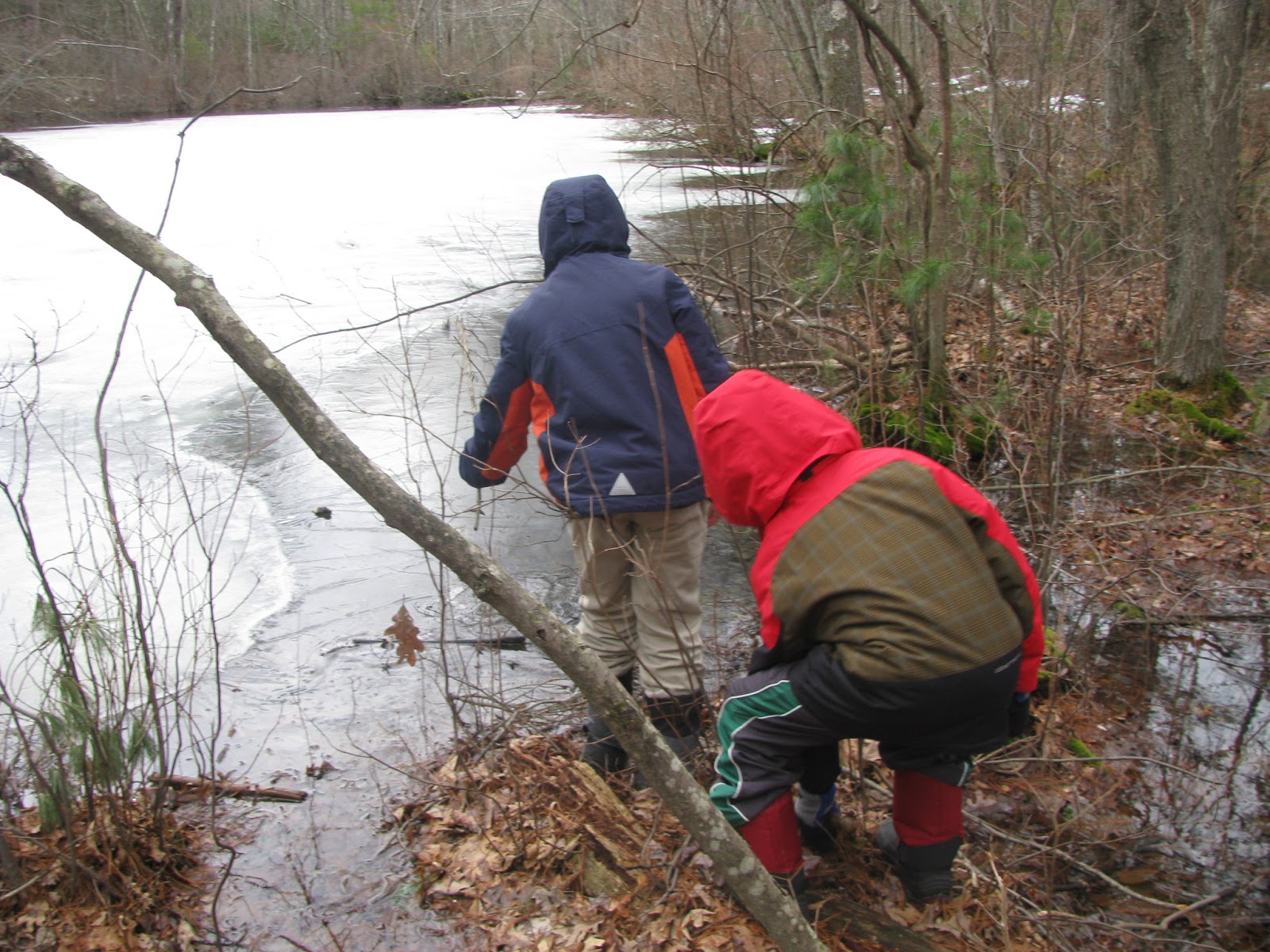
At the pond we checked out the edge, but the middle was still iced
over and we decided that there would be no amphibian eggs there yet. We
sat on a log and had a snack of popcorn while our instructor showed us
pictures of spotted salamander and wood frogs, and talked about vernal
pools.
Then we followed the trail to a much smaller vernal pool. We found a large slug in there. It looked like it had drowned. This pool was shallow enough to see to the bottom very well. We also found an "oak apple gall" and learned how a small wasp had laid an egg on an oak leaf. The egg hatched and the tiny larva started eating and the leaf then grew a rounded growth over this irritation. This growth is a gall, and the larva developed in it. When it developed into an adult, it then chewed a hole in the gall to get out.
Next, we followed a trail to an unusual and cool place in this forest. You'll have a ask a Green Ranger about it! The trail went up and down over rocky hills and we crossed a wooden bridge over a stream. We arrived at our destination, and after checking out all of the interesting things there, we had hot chocolate with marshmallows! We followed a stream downhill and explored the wetland that formed below. Skunk cabbage was blooming. It is a very early wetland bloomer with a thin, rod-like flower inside a mottled purplish "hood" (spathe). It has a slightly stinky smell and is very unusual because it can create its own heat (thermogenesis). The smell and, probably the heat as well, attract early pollinators - flies and beetles. (see picture of skunk cabbage below.) We also found a red-backed salamander and a red eft (land-living part of the newt's life cycle) under a log! Then we had to hurry back to get to the Science Center for pick-up time.

It's the middle of March now, so we took a field trip to Needham's Town Forest to look for vernal pools. Very soon, these pools will be visited by breeding amphibians - frogs, toads, salamanders. A "vernal pool" is a small pond that forms in woods in the spring from melting snow and spring rains. These are good places for amphibians to breed because they dry up or shrink a lot in summer, so fish usually cannot live in them, and fish love to eat amphibian eggs! The eggs hatch and then the tadpoles grow and develop into their adult forms before the pool dries up.
The earliest arrivals to vernal pools around here are yellow-spotted salamanders and wood frogs. They are expected between the middle of March and the end of the month. The first warm, rainy night in this breeding season is a good time to look for salamanders and wood frogs heading to the pools. They lay jelly-like eggs that stick together in egg masses in the water.. During breeding season, you can often locate a vernal pool by listening for what sounds like ducks quacking, but you don't see any ducks - those are wood frogs calling!


Then we followed the trail to a much smaller vernal pool. We found a large slug in there. It looked like it had drowned. This pool was shallow enough to see to the bottom very well. We also found an "oak apple gall" and learned how a small wasp had laid an egg on an oak leaf. The egg hatched and the tiny larva started eating and the leaf then grew a rounded growth over this irritation. This growth is a gall, and the larva developed in it. When it developed into an adult, it then chewed a hole in the gall to get out.
Next, we followed a trail to an unusual and cool place in this forest. You'll have a ask a Green Ranger about it! The trail went up and down over rocky hills and we crossed a wooden bridge over a stream. We arrived at our destination, and after checking out all of the interesting things there, we had hot chocolate with marshmallows! We followed a stream downhill and explored the wetland that formed below. Skunk cabbage was blooming. It is a very early wetland bloomer with a thin, rod-like flower inside a mottled purplish "hood" (spathe). It has a slightly stinky smell and is very unusual because it can create its own heat (thermogenesis). The smell and, probably the heat as well, attract early pollinators - flies and beetles. (see picture of skunk cabbage below.) We also found a red-backed salamander and a red eft (land-living part of the newt's life cycle) under a log! Then we had to hurry back to get to the Science Center for pick-up time.
Subscribe to:
Posts (Atom)